
AI has quickly woven itself into the fabric of the creative industries, sparking both excitement and anxiety. While some narratives paint AI as a looming threat to traditional design roles, the reality inside professional studios is far more grounded. Designers are not being replaced – they are adapting, experimenting and integrating AI as part of a broader toolkit. When used thoughtfully, AI becomes a supportive extension of the creative process, helping designers work smarter without compromising craft, originality or strategic thinking.
AI as a Partner, Not a Replacement
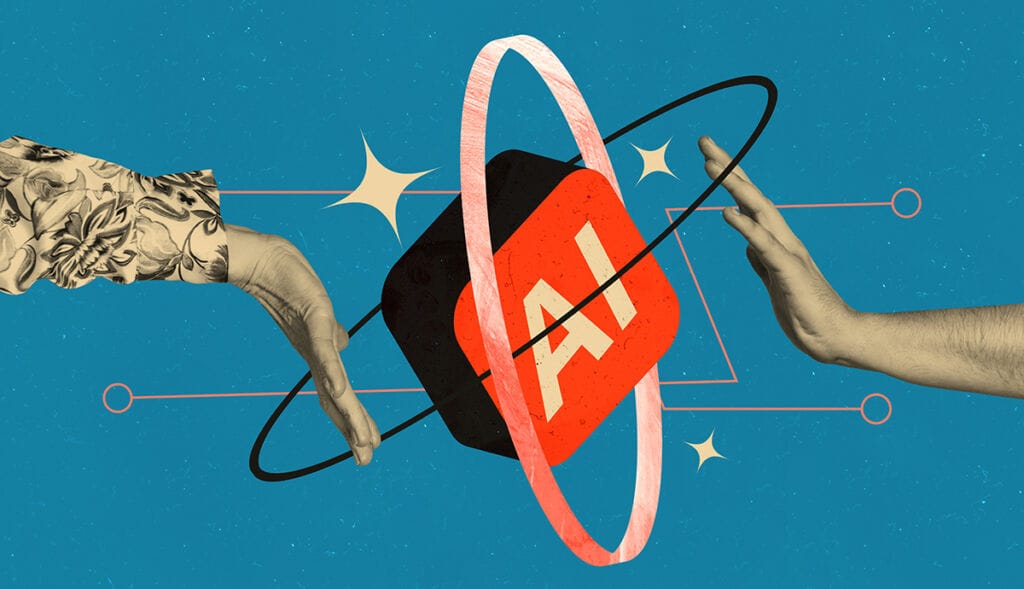
Design has always evolved alongside technology. The shift from hand‑drawn layouts to digital software didn’t eliminate designers, it empowered them. AI sits within that same lineage. It offers speed, variation and computational power, but it still relies on human direction, taste and judgment. Designers remain the authors of the work, AI simply assists with the heavy lifting. This partnership allows creatives to explore ideas more freely. Early‑stage concepting becomes faster, experimentation becomes more playful and designers can push boundaries without being constrained by time‑consuming manual tasks. AI becomes a tool for creative exploration rather than a shortcut.
The Irreplaceable Role of Human Insight
Great design is rooted in understanding people – their behaviours, emotions and cultural contexts. AI cannot replicate this human insight. It can generate options but it cannot determine what is appropriate, meaningful or strategic for a brand. That requires a designer’s eye, intuition and experience. This is why creativestrategy remains central to design practice. Designers consider brand history, audience expectations, tone of voice and long‑term goals. AI can support execution, but it cannot define direction. The human element remains the driving force behind every successful design outcome.
Enhancing Workflow Without Diluting Craft
One of AI’s greatest strengths is its ability to streamline repetitive or technical tasks. Designers can use AI to automate resizing, generate quick mock‑ups or test visual variations. This frees up time for deeper creative thinking – the kind that requires imagination, problem‑solving and emotional intelligence. By integrating AI into the workflow, designers can maintain the integrity of their craft while improving efficiency. It becomes a way to accelerate production without sacrificing quality or originality.
Keeping Design Authentic in a Tech‑Driven Era
As AI‑generated content becomes more common, authenticity becomes even more valuable. Brands want design that feels intentional, human and emotionally resonant. Designers who use AI strategically without relying on it as a creative crutch can maintain the authenticity that audiences crave. This balance ensures that AI supports creativity rather than diluting it. The designer remains the storyteller, AI simply helps shape the tools.
A Future Built on Collaboration, Not Competition
The future of design is not AI versus humans, it’s humans supported by AI. The most compelling creative work will come from designers who understand how to blend technology with intuition, strategy and craft. AI will continue to evolve, but its role will remain supportive, not dominant. Designers who embrace AI as a tool will find new ways to innovate, experiment and elevate their work. The industry isn’t being replaced, it’s being expanded.
Want to explore how human‑led design and smart technology can elevate your brand? Contact Fresco Creative for your next design project.